
Picking up the Threads
How China Lives in the World


Welcome back to Hǎi 海, a new platform for global China stories from Asia Society’s ChinaFile. This week’s opening essay is the second in a series by writer and former Wall Street Journal correspondent Shen Lu.
And as usual, subscribe for updates about Hǎi and our community, and continue to alert us to about events and media you’d like to see in our listings.
Picking up the Threads
By Shen Lu
On a hot, humid day in mid-May, I joined a group of elderly Chinese immigrant women for a textile workshop at a senior center in my Brooklyn neighborhood, Sunset Park.
After I greeted my classmates—a dozen or so gray-haired women from different parts of China and Hong Kong—I settled into a corner of the classroom next to a heap of cloth scraps, strands of thread, and balls of yarn all jumbled together. The workshop’s teacher, my friend Lin Qiqing, handed me a set of embroidery tools.
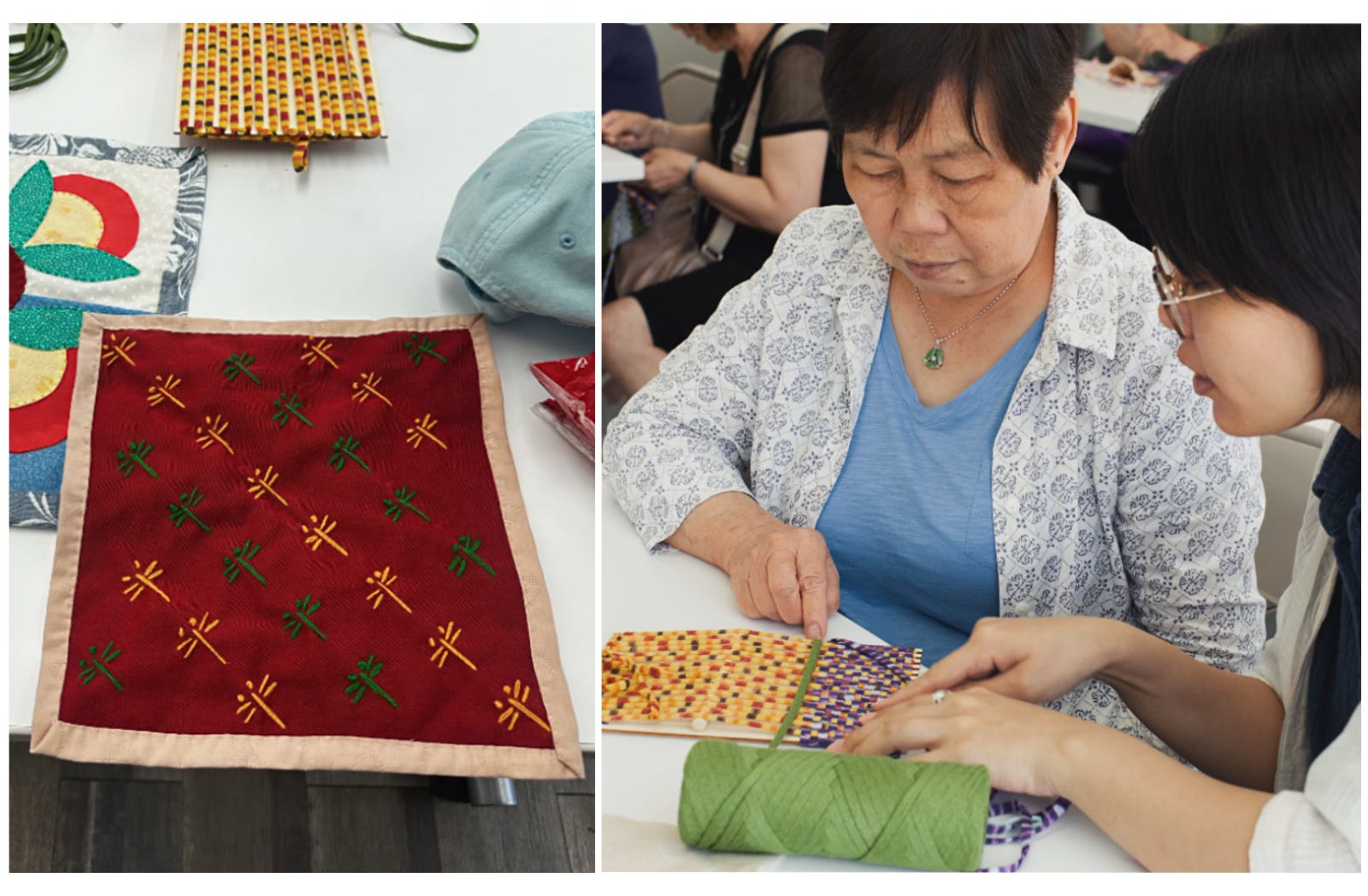
This was one of the final sessions of a seven-week workshop led by Qiqing, a textile artist, as part of a community arts engagement program supported by the Brooklyn Arts Council. Over the course of the workshop, the women created weavings, embroidered pieces, patchwork, and mixed-media works. By the time I sat in, most of the women were working on their final pieces, readying themselves for an upcoming exhibit at the senior center. A few of them were discussing color choices for thread. One woman, heading off to work, turned in her finished assignment: a maroon square of cotton embroidered with minimalist green and yellow dragonflies stitched in a repeating, diagonal pattern. The rest of us marveled at her elegant design.
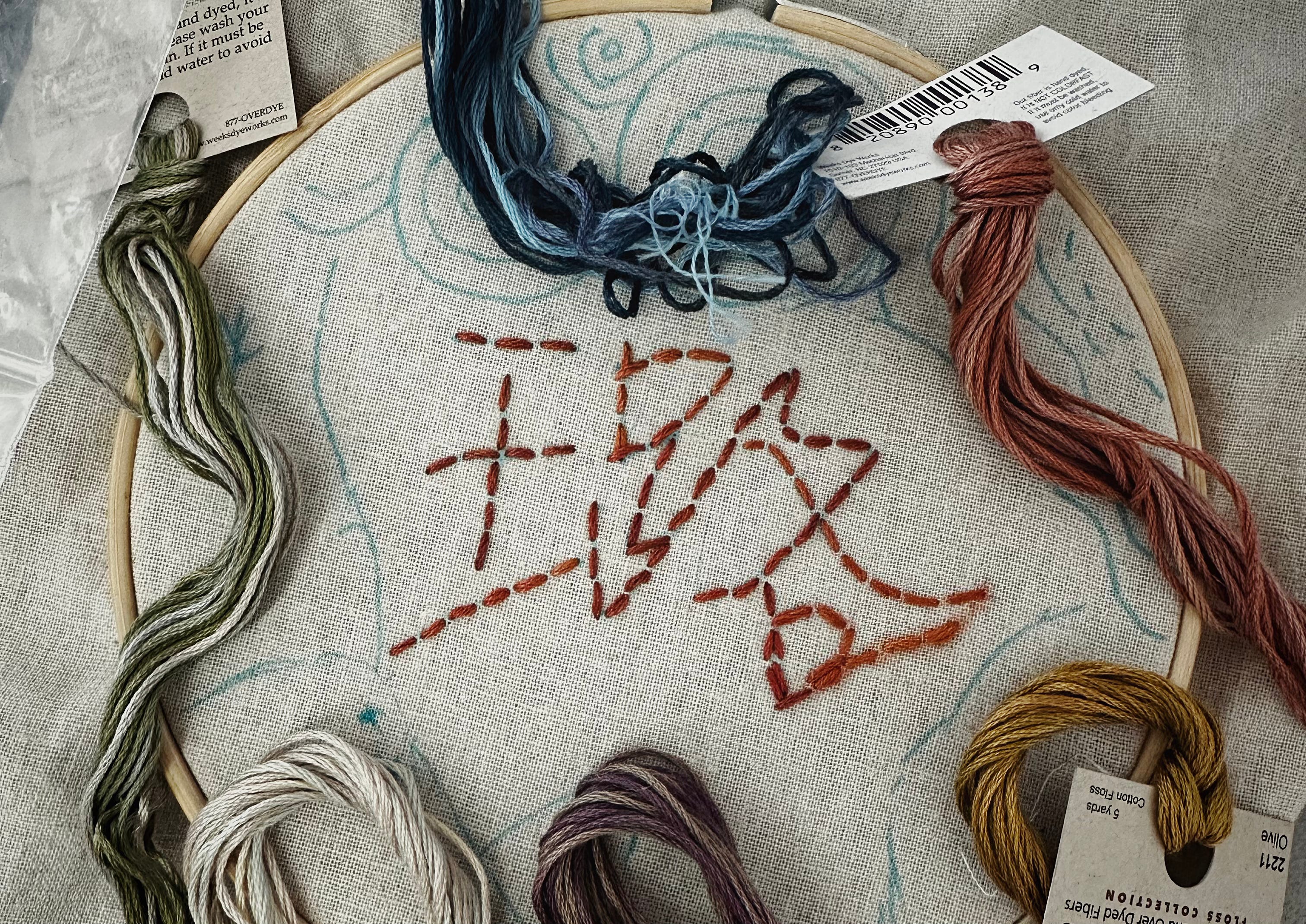
I picked a skein of terracotta-colored embroidery floss and began stitching over the character for my Chinese given name, 璐 (Lu), which I’d written on a square of beige linen with a water-soluble marker. The small, even running stitches came together quickly. The harder part was following the curves and turns of my handwriting. I slowed down around each bend, shortening the stitches so the floss would trace the script. When I finished sewing, I walked around the classroom, showing my embroidery hoop to the women who had finished the same assignment weeks ago.“璐璐!” one of them exclaimed.
No one calls me Lulu except for my family in China. In the U.S. I insist people call me Shen Lu, my full name in the Chinese name order, because being addressed as “Lu” gave me goosebumps when I first arrived as a student 15 years ago. In China, if someone’s given name is only one syllable like mine, they are rarely called by their given name alone, except in close relationships like family. But when my Sunset Park classmate hailed me with a cheerful “Lulu” as my own grandmother would, my heart melted. In return, I call the older women in the workshop 奶奶 nainai—granny—an expression of affection and respect for older Chinese women with whom I feel a sense of familiarity.
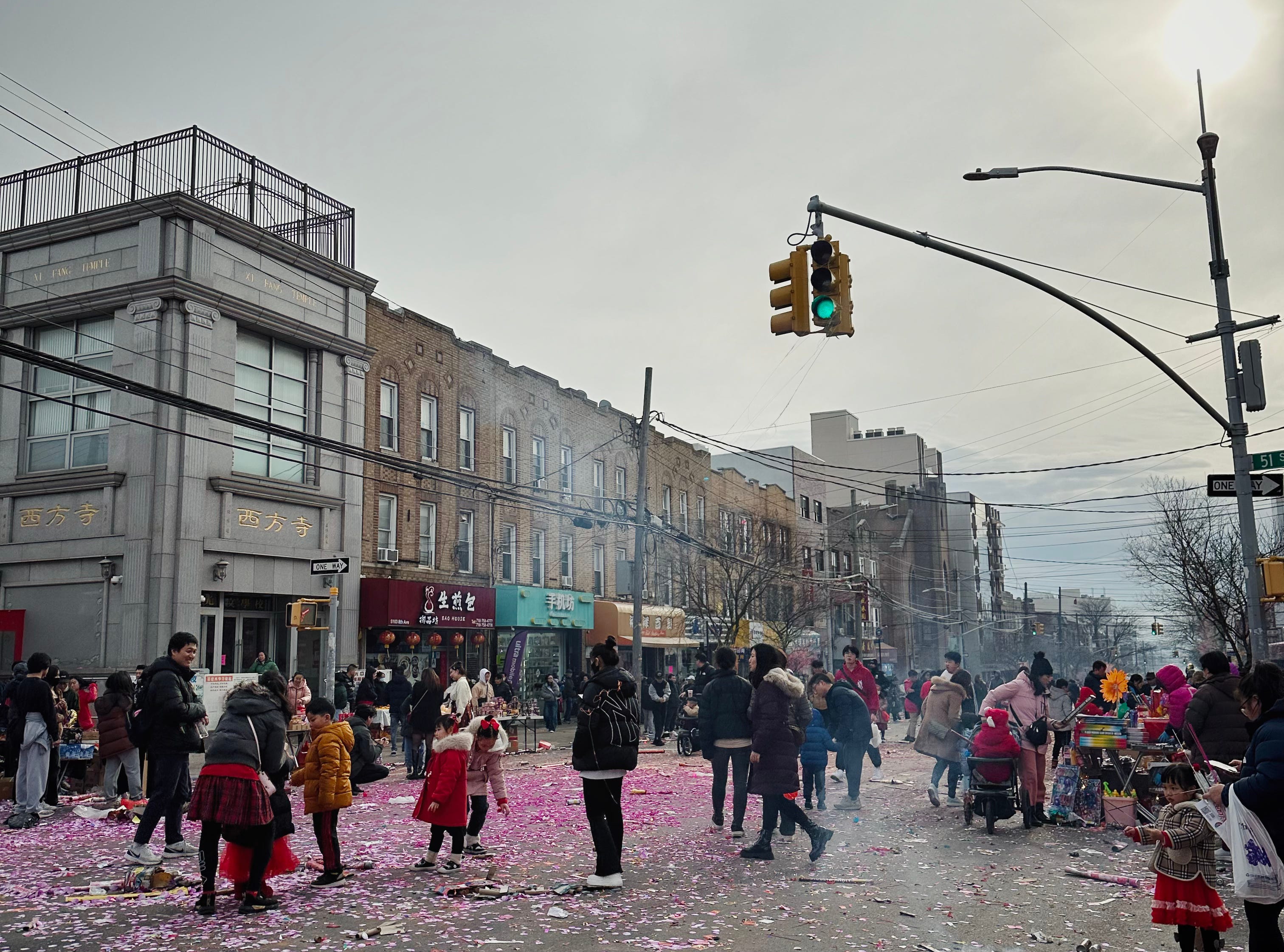
I have lived in Sunset Park for almost six years. A 15-minute walk from my house lands me in the heart of this bustling Brooklyn Chinatown, lined with grocery shops, vegetable stands, fish-mongers, and the kind of general stores sporting piles of kitchen utensils, household supplies, and gardening tools. I moved to Sunset Park for easy access to Chinese groceries I couldn’t find elsewhere: fresh water bamboo, whole yellow croaker imported from China, freshly-made tofu sold in individual takeaway containers instead of mass-produced plastic packaging. But I had never found my way into the life of the community; I felt sheepish calling it “my neighborhood.”
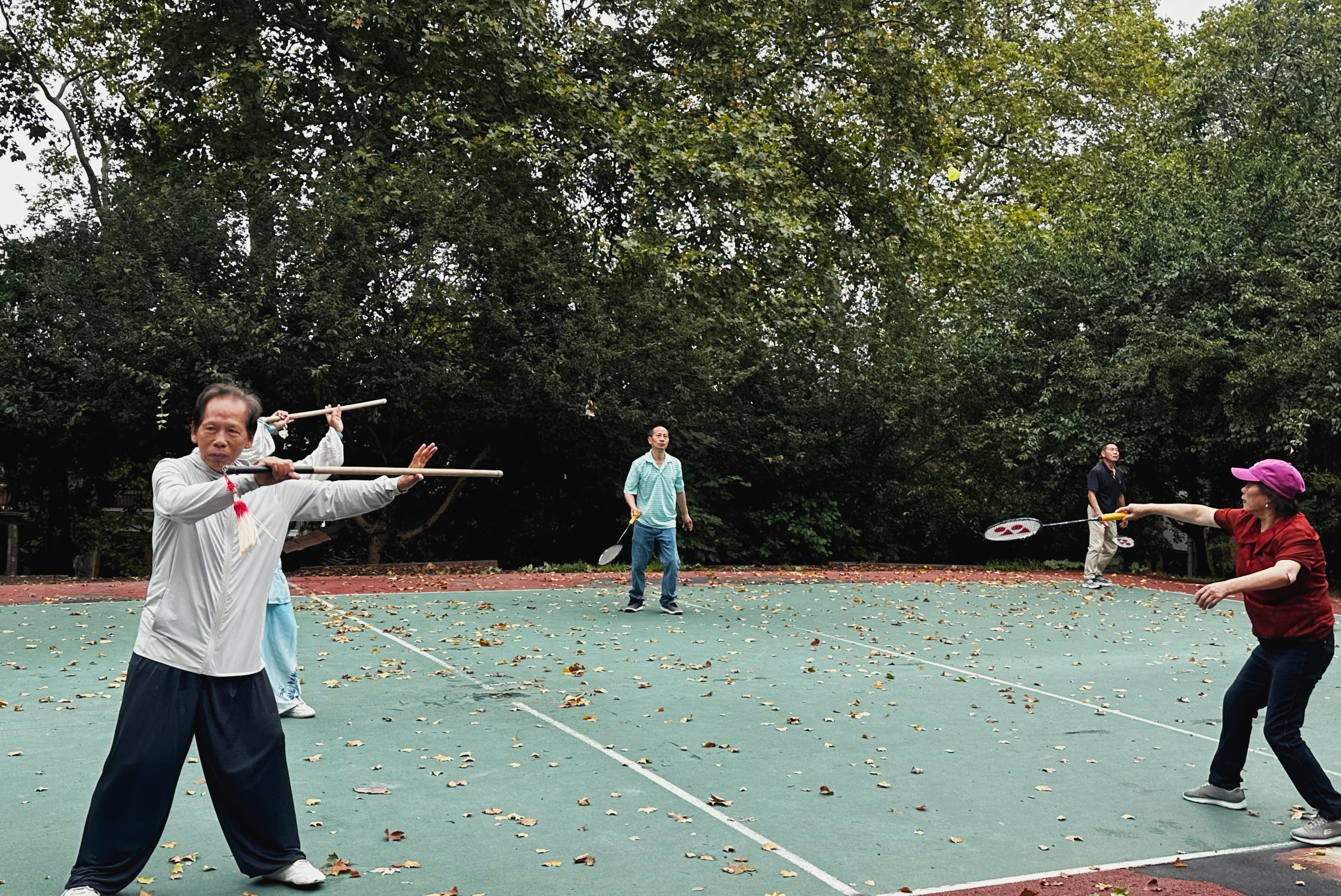
Sunset Park is mostly home to working-class immigrants. I am a writer and journalist who came to the U.S. by way of higher education. I didn’t know how to fit in. My contact with the locals was limited to transactions for food or services like massages. Sometimes, uninvited, I joined groups in the park doing what is generally called guangchangwu, or “square dancing,” for the urban plazas or squares in which its adherents gather. But I always felt like an intruder among the middle-aged Chinese immigrants performing synchronized aerobics-like routines to the Mandopop hits of the 2000s, piped out of a portable speaker.
Once, a massage therapist, an immigrant from Fujian province in her late 30s, asked if I did nails or massages for a living, as she worked through the stubborn lumps in my tight shoulders. After an awkward pause, I said, “I click a mouse.”
At the time, I was a China correspondent for The Wall Street Journal. I interviewed tech workers and startup executives in Silicon Valley and middle-class Chinese professionals in New York, but I rarely got a chance to write about the working-class Chinese immigrants in my neighborhood. The lives of people like the massage therapist wouldn’t interest my editors much unless a major event took place in Sunset Park, or if its voters swung an election. I felt uncomfortable telling her what I did for a living, and I didn’t want to have to explain where I worked or what I covered.
The embroidery workshop gave me my first real experience of connecting with the Chinese community in Sunset Park. The initial encounter was almost thrilling, the kind you feel when connections form in the most serendipitous way.
I have spent most of my career writing about China from outside its borders. Over time, sources became a very narrow category of people: analysts, executives, academics, policy experts, activists, middle-class Chinese at home and in the diaspora. I knew China well, the China that interests the mainstream international press. Yet there were vast swaths of Chinese life I had stopped experiencing and seeing.
After I left my former employer last summer, I spent months wondering whether I could write about or “do China” again. Recent trips to visit family in China after years being abroad had me questioning whether I truly knew my country or my people. I dug out recordings from years earlier of my conversations with my grandparents, in which they’d recounted the ups and downs they’d lived through during China’s political upheavals and economic boom. I felt as though I didn’t even know my own family well.
As I sit in my apartment in Sunset Park, mesmerized by the most mundane details my now dementia-struck grandfather explained in a voice still ringing with vitality—about the painstaking process of making paper out of bamboo, about eating 13 big bowls of rice after finishing a 14-hour work day making paper during the Cultural Revolution, about earning his first 10-yuan daily income in the 1980s—I am reminded of how much of the richness of life I have missed as someone who has made a career of writing about China for an audience who sees China mostly as a strategic adversary.
The grannies in Sunset Park found me thirsty for what I think of as ordinary life and proximity to ordinary people, as though I’m making up for all the lost time I could have spent with them, or better yet, with my own grandparents, even if we may not be able to carry on a conversation beyond the banalities of everyday life.
When I popped into their class in May, no one asked why I was there. Qiqing was helping the women draft their artist statements for an exhibit to showcase their work. It’s challenging enough for professional artists to write artist statements, Qiqing told me, but getting the women in her workshop to write their statements was even harder. They were not used to talking about themselves, and few considered their embroidery and patchwork art, nevertheless their life stories, worthy.
To me, the art of these elderly immigrant women was deeply moving. In the bold colors, blooming peonies, and cheerful birds, I saw their lived experiences and memories as peasants, garment workers, immigrants, mothers, and daughters carried across borders from Asia to the U.S. I was also struck by the grit and quiet dignity of the women sitting in front of me. After crossing borders and enduring decades of grueling labor and life, they still carried within them the most tender desires for a good life, and a better one.
I struck up a conversation with Xuezhen Lin, as she was weaving through a tri-colored cross-body bag. I asked why she had joined the workshop. She said it was because she was 没文化, mei wenhua, uncultured. She kept saying her work was elementary, not as delicate as some of her classmates’ embroidery. I am acutely familiar with such low self-esteem. I have seen variations of it in my grandmothers, my mother, my women friends, and myself.
Granny Lin is two years younger than my own grandmother. She worked in rice paddies as a child and young woman. In 1971, she joined China’s national railway system as a trainee machinist. She later worked as a train attendant, learning how to read and write so she could pass the qualification exams. She moved to New York from her hometown of Fuzhou during the Covid-19 pandemic to reunite with her family.
I couldn’t imagine what it was like for her to uproot her comfortable retirement life and wind up in New York at the height of Covid, where immigrants like her were frequently spit on, pushed around, and assaulted. I asked her how her American life has been. She smiled, “It’s fine. Every day I take three walks in the park, once in the morning, once after lunch, and once in the evening.” I blurted out, “Me too!” For a split second, I felt closer to her than to my millennial friends working in tech or media.
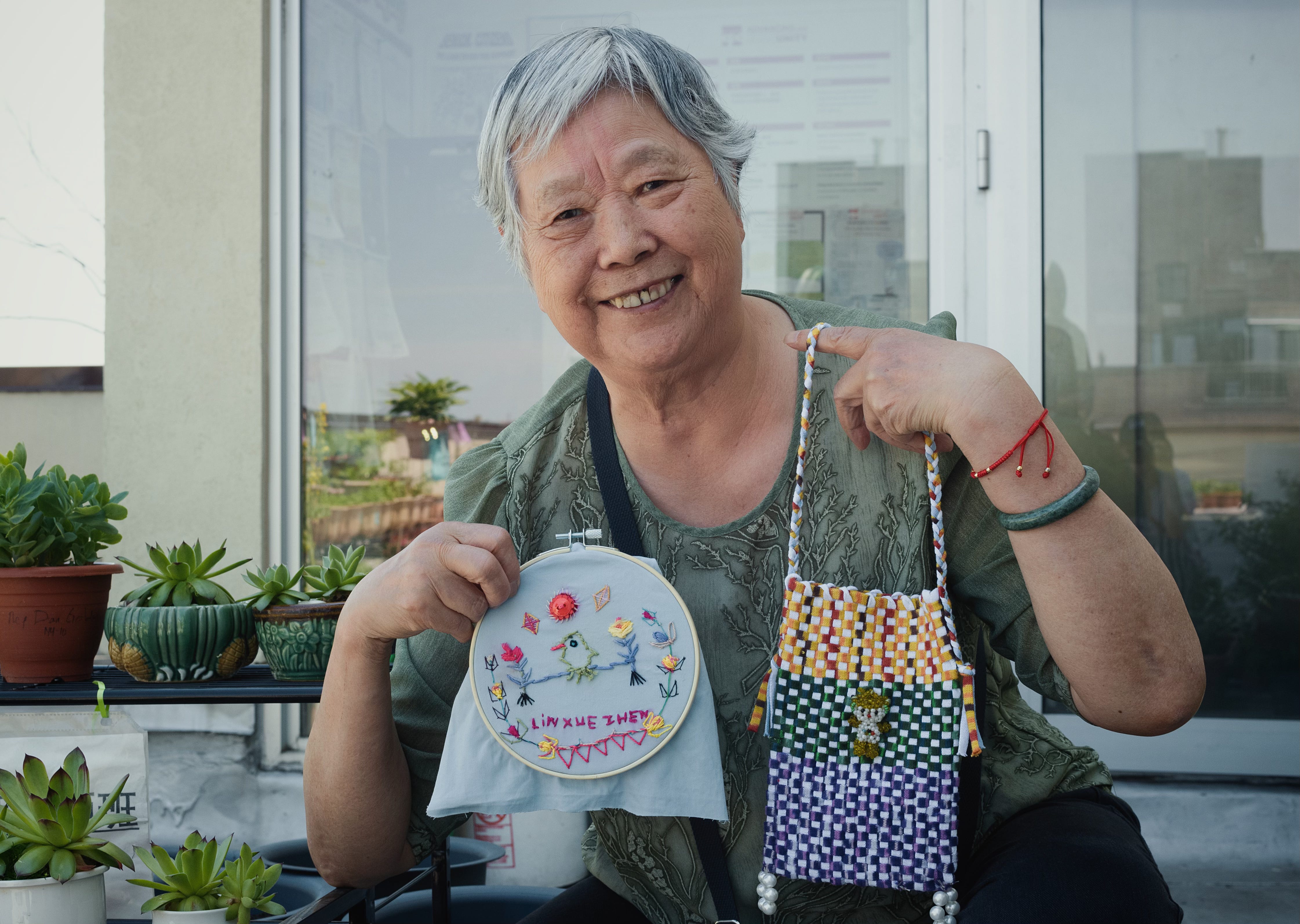
I went back for another class and then for the opening of the group’s exhibit on May 26, where I was assigned the task of photographing the event. When Lin introduced her work at the ceremony, I noticed her cross-body bag had a beaded Fuwa, the 2008 Beijing Olympics mascot, stitched onto it. She explained to the audience the beadwork was done by her granddaughter, who had told her, “Waipo, put this on. It’ll look prettier.” My tears streamed down as I was photographing her. I at the time was deep in the editing process of an essay I wrote about my grandmother. I wished I’d sat alongside her while she made bulky winter slippers out of used clothes for each of her children’s homes.
Granny Lin was one of the few bold women who took the mic to introduce themselves and their art at the opening ceremony. She emphasized that she was a first-time student: “I am not very good at it,” she concluded her speech. She was overly humble. She had done embroidery work as a young woman.
A few other women in the workshop had previously worked in garment factories in Asia and the garment district in New York. They were absolute masters.
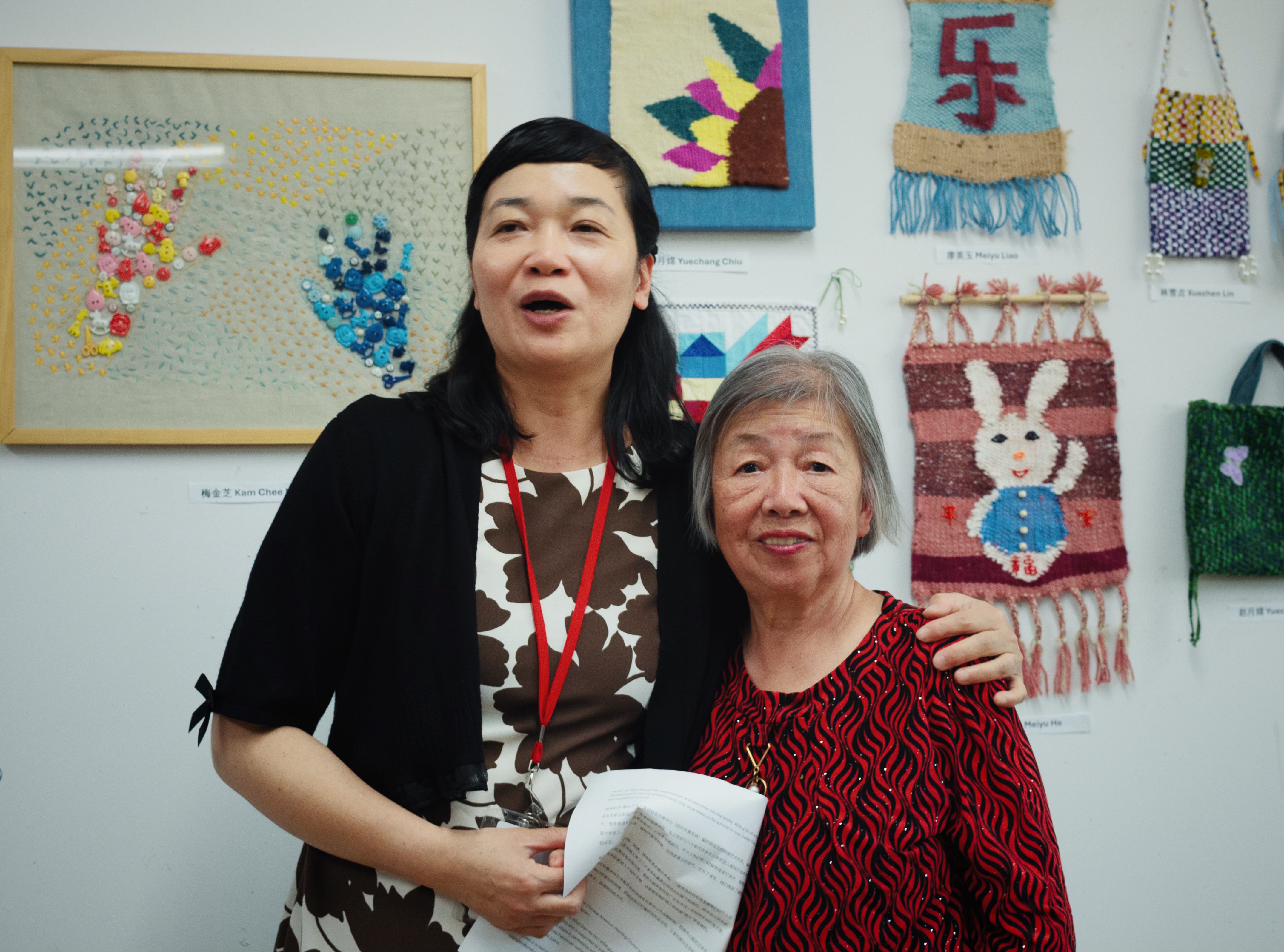
The centerpiece of the exhibit featured buttons Kam Chee Mui had saved from a New York garment factory where she’d worked for over 20 years, sewn onto traced outlines of her own hands, evoking the show’s title, Hands at Work.
Granny Mui was born in Guangdong province and grew up in Hong Kong, then worked for more than 30 years as a seamstress in New York. She was proud to be responsible for making reference samples for mass production. Those samples had to be so precise even the slightest excess in seam allowance wouldn’t be acceptable.
At the exhibit, Granny Mui was too shy to address the audience. But I could tell that she took the occasion seriously from the touch of makeup and slightly formal, black-and-red outfit she was wearing that day. When she held her hands over the handprints in her piece hanging on the wall, the audience broke into applause.
As I moved through the space with a camera slung over my shoulder, I was transported back to my college days, when I was on spot news assignments, covering events in Iowa City.
I became a journalist because it took me to unexpected places to meet people I’d otherwise not meet. I loved telling stories that captured the complexities of human conditions and societies. That passion has worn thin over the past few years, when my reporting narrowed sharply to focus on geopolitical tensions. That day in Sunset Park, surrounded by this group of immigrant women, I was struck anew by the excitement of being the journalist I had once wanted to be.
Hǎi Points: Our top picks from Global Chinese media
Our selection of Chinese- and English-language podcasts, newsletters, articles, videos, and other media from the global Chinese world.
The Weirdo Podcast 不合时宜
Watching the Trial of a Chinese Date Rape Case in a German Court Filled Me with a Sense of Collective Outrage 在德国法庭见证华人迷奸案的审判,我感到一种集体的愤怒
Into Asia, Chang Che
Tall Tales 中杯美事
Does Driving a Truck Pay More Than Working in an Office? A Look at 10 Jobs with the Biggest China–U.S. Salary Gaps 开卡车比坐办公室挣得多?聊聊中美薪酬反差最大的10个职业
Leftover Talk 边角聊
Return to 1960: The Lives of Indonesian Chinese in China 归来一九六〇:印尼华侨的中国生活
Calling the Shots, by Ivy Yang
Voice the Voiceless 低音
When Civilization Falls Silent: The Healthcare Struggles of Chinese Immigrants Behind Europe’s Universal Healthcare System 文明的失语:欧洲“全民医疗”制度背后,华人移民的海外看病困境
Reflections from Bangkok Pride: The Cries We Momentarily Forgot 我的曼谷骄傲游行笔记:那些暂时被忘记的哭声
Elephant Room
Jasmine Sun
THE CHOW
—Jiayun Feng
Cultural and Community Events
NEW YORK
Art
Inner Landscapes: Concurrent solo exhibitions by Liane Chu and Yehong Mao, who “approach painting as a way of navigating experience” — Through August 1, LATITUDE Gallery
Ellen Pau: She Moves: “the first US survey exhibition of the work of Ellen Pau, one of Hong Kong’s most influential and pioneering artists” — Through August 16, SculptureCenter
Age of the Captain: A solo exhibition by Ruoxin Sun, featuring 3D-printed and metal sculptural installations — Through July 31, Tutu Gallery
Shared Lines: Asian American Stories on Route 66: Illustrator Sammy Yuen “explores some of the lesser-known stories of Route 66 and the integral part they play in U.S. history” — Through September 27, Pearl River Mart
a dictionary, a loom, a manifesto …: “the bookmaking practice of artist and publisher Chang Yuchen” — Through August 30, Printed Matter, Inc.
Film
25th New York Asian Film Festival 2026 — July 10-26, Multiple locations
Characters Disappearing, a screening of the 2025 independent film that explores the 1970s Asian American Movement through the lives of three characters in New York City’s Chinatown; followed by a Q&A with the director — July 20, 25, 26 Roxy Cinema
Performance
Chinese Arts Week at Lincoln Center
Shen Wei Dance Arts | Guangdong Modern Dance Company — July 22-25, Hearst Plaza
Awakening Lion + Yingge Dance 南国醒狮 x 英歌 — July 22, The Dance Floor at Josie Robertson Plaza
Living Music: Ian Chang — July 22, David Rubenstein Atrium
Chinatown Records Block Party — July 22, The Dance Floor at Josie Robertson Plaza
Shanghai Restoration Project and Tebza Majaivane — July 23, The Dance Floor at Josie Robertson Plaza
About Face: Disrupting Ballet — July 23, David Rubenstein Atrium
Kung Fu Hip Hop 功夫街舞 — July 24, The Dance Floor at Josie Robertson Plaza
Chinatown Records Time Machine — July 24, The Dance Floor at Josie Robertson Plaza
Hanggai: “an eight-member Inner Mongolian folk ensemble that mixes the ancient traditional art of Khoomei throat singing with contemporary punk, emo, and metal rock styles” — July 25, The Dance Floor at Josie Robertson Plaza
Chinese electronic duo TAIGA — July 25, The Dance Floor at Josie Robertson Plaza
Qi Yu - Guzheng Meets Jazz — July 26, Lincoln Center
Culture
Chinese Opera: A Century of Dreams: “Inspired by the renowned Peking Opera master Mei Lanfang’s triumphant 1930 American tour and the rich artistic heritage of tradition Chinese Opera, this showcase presents reinterpretations of classic Chinese stories and theatrical scenes through contemporary visual language” — July 9-29, China Institute of America
WASHINGTON, D.C.
Books and Journalism
Speaking events at JF Books, times and details here:
A House Across the Strait: Two Sisters and a Divided Memory: “In conversation with historian Tobie Meyer-Fong, Zhuqing Li discusses Daughters of the Flower Fragrant Garden, the true story of two sisters separated by China’s Civil War” — July 9
From Red China to Blue Maryland: The Political Awakening of an Immigrant Community: “Maryland State Delegate Lily Qi discusses her new memoir, Elected American: From Red China to Blue Maryland” — July 10
LONDON
Media
Podcast Carnival 中文播客嘉年华: the first in-person gathering of Chinese-language podcasters in the UK — July 18
SYDNEY
Art
Black Myth: “Drawing from the viral Chinese video game Black Myth: Wukong (2024)—a contemporary retelling of the classic novel Journey to the West—the exhibition . . . explores the dark side of myth in the modern world” — through November 15, White Rabbit Gallery
Montreal and Toronto
Film
Canada China International Film Festival, featuring a rich lineup of screenings and discussions — July 10 - August 9, multiple locations
GLOBAL 五洲四海
We’re looking for information about events everywhere there is Chinese cultural life.
Please use this form to submit your event. For questions or additional information, email editors@chinafile.com.
—Jiayun Feng
 | A guest post by
|
Hi @Shen Lu! This is great. I found myself in that ambiguity you describe — being far from home and feeling somehow not entitled to write about it, as if it had changed too much while I wasn’t there. As a fellow immigrant to Brooklyn (Italian, and I lived in China before moving to the US), I found it heartwarming how similar our experiences are. If you have time, I’d love for you to read my piece below:)
https://martinapirisi.substack.com/p/sicily-charged-me-700-to-remember?r=5kner1&utm_medium=ios